Enrich liquids with gases?
Increasing gas concentration instead of degassing
Biotech Fluidics offers equipment for highly efficient inline degassing that can remove more than 90% of dissolved gases from liquids. Inline degassers utilize vacuum to accomplish gas extraction through a gas permeable membrane. This degassing membrane is housed inside a sealed degassing chamber connected to a vacuum pump delivering stable vacuum conditions.
However, some situations require quite the opposite, i.e., increased concentration of certain gases within given liquids. Applications include chemical reactions with gases where a well-defined gas level would translate into faster, more complete chemical reactions, improved product uniformity in industrial applications and more sustainable processes due to reduced emissions and lower energy consumption.
Setup for gas enrichment
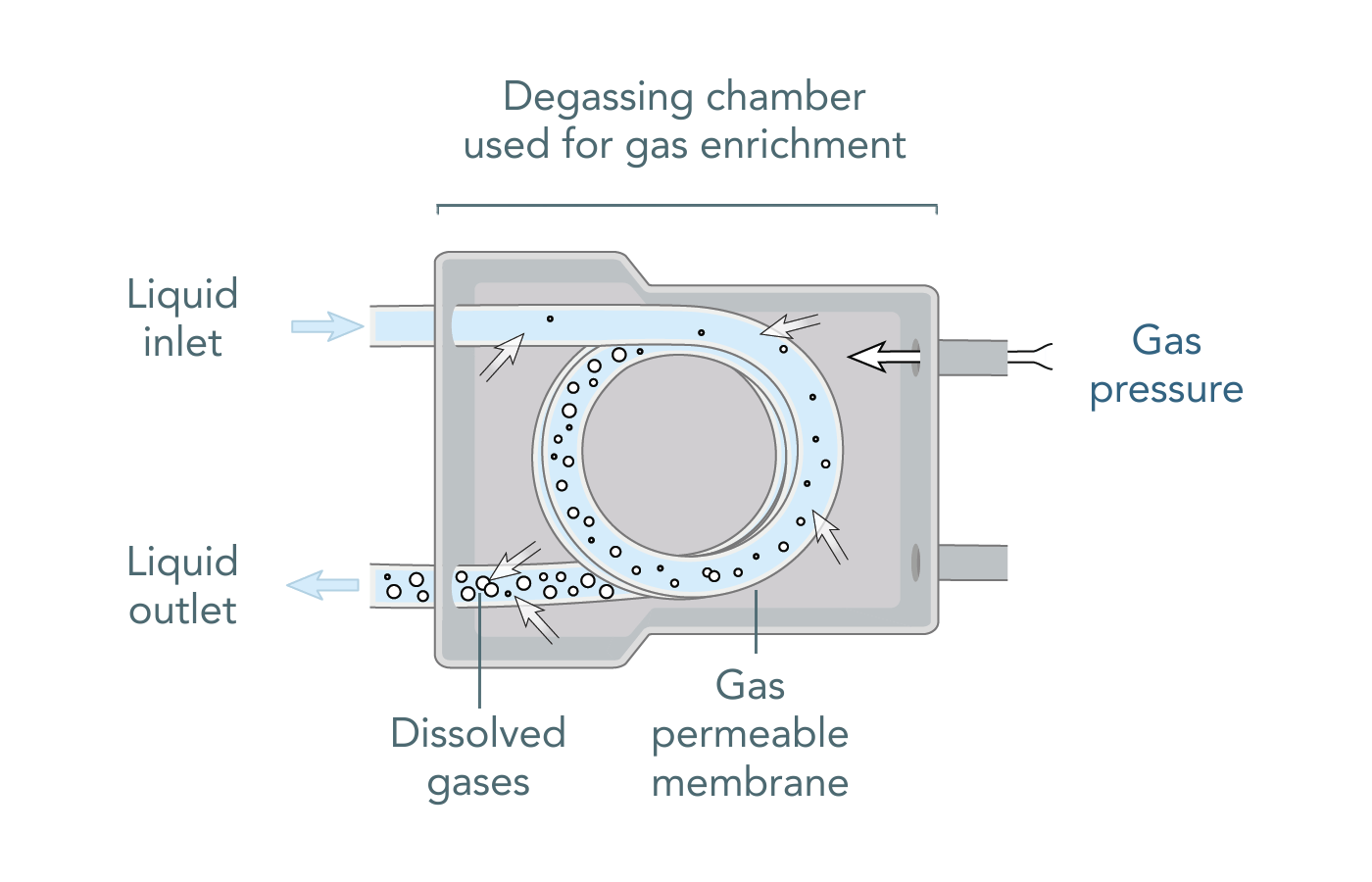
This case study shows how gas enrichment into liquids can be accomplished using standard components available from Biotech Fluidics, utilised in an unconventional setup. The principle of gas accumulation in fluids was demonstrated by pumping tap water through a preparative degassing chamber containing a tubular membrane. The chamber was exposed to a constant over-pressure of air allowing regulation of the gas content within the liquid in a controlled manner. Gas enrichment was evaluated as change in oxygen level before and after the pressurised chamber using flow through oxygen meters.
Proof of principle data
As displayed in the figure below, the increase in absolute oxygen concentration was about 3-7 mg/mL, corresponding to more than 100% amplification of gas level at the most favourable conditions. The enrichment of oxygen was highly temperature dependent, while the change of flow rate displayed an almost negligible impact with this degassing chamber. This highlights the increased solubility of dissolved gases at lower temperatures and indicates that the current conditions were well adapted for the size of the selected gas permeable membrane.
At 10 °C and a flow rate of 7 mL/min, the increase in gas concentration exceeded 100%, which corresponded to 6.7 mg/mL in absolute terms, and at 20 °C the increase also reached beyond 100% at this fluid velocity. At higher temperatures the relative rise in oxygen level was less pronounced and the enrichment reached 2.6 mg/mL at 50 °C and 7 ml/min, which corresponded to a 67% increase.

Experimental details: An 0.15 MPa overpressure of air was applied to a preparative degassing chamber with tubular membrane having 5.4 mL internal volume (model 9000-1523). Through this chamber was temperature-controlled tap water (10, 20, 30, 40, or 50 °C) pumped at two different flow rates (7 or 14 mL/min). The amount of dissolved oxygen was monitored continuously before and after the chamber using inline flow-through oxygen meters.
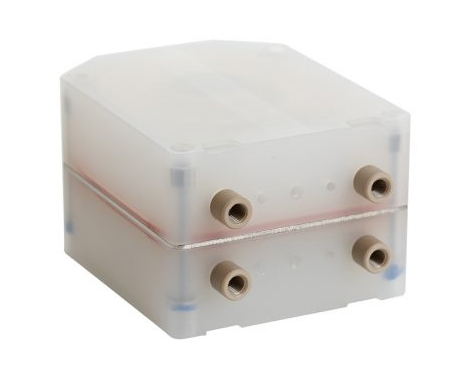
The model 9000-1523 preparative degassing chamber with tubular membrane having 5.4 mL internal volume used in this work.
Conclusions and more information
The data in this report shows the dual functionality of the degassing chamber, thereby proving it to work also as a terrific device for dissolved gas enrichment. With such a chamber one can now easily add an inline unit to boost solutions with the gases of interest.
Learn more about the Biotech Fluidics degassing chambers at the product webpages linked below or contact Biotech Fluidics to discuss the most appropriate chamber for your application of gas enrichment.