-
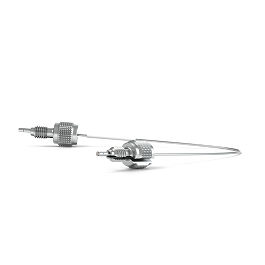 MarvelX UHPLC Connection Systems from IDEX Health & Science maintain zero dead volume and prevent peak tailing. MarvelX UHPLC finger-tight fittings do not depend on ferrules, which significantly reduces required torque and enables many more connects and disconnects. Furthermore, they are virtually impossible to over-tighten by hand, which limits wear and increases product life. Enhanced high tech tip sealing also ensures zero dead volume (ZDV) and better chromatography results. Our PEEK-Lined system offers a truly biocompatible PEEK inner layer, serving as the fluid pathway, and is perfect for bio-inert UHPLC applications. Surrounded by a robust stainless steel structure, our durable PEEK-Lined connection system is rated at 19,000 psi (~1,310 bar) for routine use â with a maximum over pressure of up to 23,000 psi â and includes flexible tubing that can be replaced independent of fittings
 -
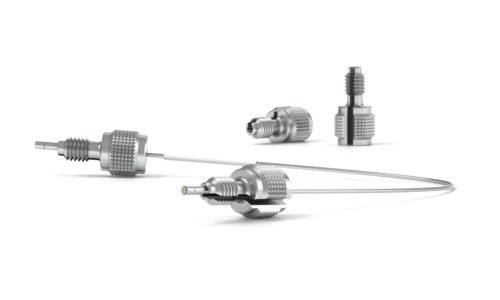 MarvelX UHPLC Connection Systems from IDEX Health & Science ensure zero dead volume and prevent peak tailing. MarvelX UHPLC finger-tight fittings do not depend on ferrules, which significantly reduces required torque and enables many more connects and disconnects. Furthermore, they are virtually impossible to over-tighten by hand, which limits wear and increases product life. Enhanced high tech tip sealing also ensures zero dead volume (ZDV) and better chromatography results. Our durable stainless steel connection system is rated at 19,000 psi (~1,310 bar) for routine use â with maximum over pressure up to 29,000 psi â and includes flexible tubing that can be replaced independent of fittings.
 -
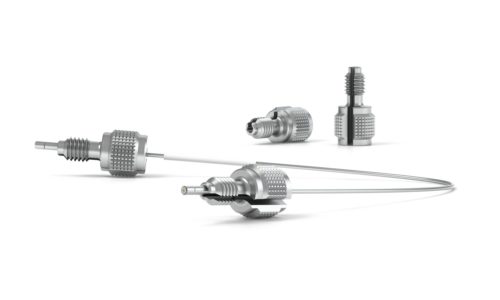 MarvelX UHPLC Connection Systems from IDEX Health & Science ensure zero dead volume and prevent peak tailing. MarvelX UHPLC finger-tight fittings do not depend on ferrules, which significantly reduces required torque and enables many more connects and disconnects. Furthermore, they are virtually impossible to over-tighten by hand, which limits wear and increases product life. Enhanced high tech tip sealing also ensures zero dead volume (ZDV) and better chromatography results. Our durable stainless steel connection system is rated at 19,000 psi (~1,310 bar) for routine use â with maximum over pressure up to 29,000 psi â and includes flexible tubing that can be replaced independent of fittings.
 -
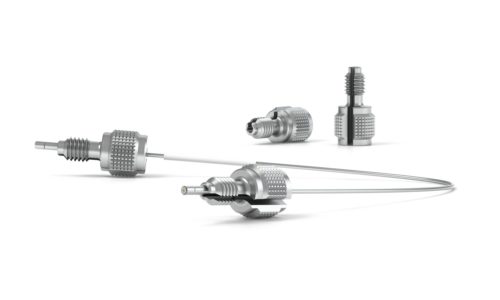 MarvelX UHPLC Connection Systems from IDEX Health & Science ensure zero dead volume and prevent peak tailing. MarvelX UHPLC finger-tight fittings do not depend on ferrules, which significantly reduces required torque and enables many more connects and disconnects. Furthermore, they are virtually impossible to over-tighten by hand, which limits wear and increases product life. Enhanced high tech tip sealing also ensures zero dead volume (ZDV) and better chromatography results. Our durable stainless steel connection system is rated at 19,000 psi (~1,310 bar) for routine use â with maximum over pressure up to 29,000 psi â and includes flexible tubing that can be replaced independent of fittings.
 -
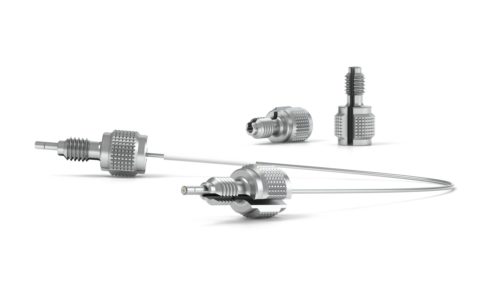 MarvelX UHPLC Connection Systems from IDEX Health & Science ensure zero dead volume and prevent peak tailing. MarvelX UHPLC finger-tight fittings do not depend on ferrules, which significantly reduces required torque and enables many more connects and disconnects. Furthermore, they are virtually impossible to over-tighten by hand, which limits wear and increases product life. Enhanced high tech tip sealing also ensures zero dead volume (ZDV) and better chromatography results. Our durable stainless steel connection system is rated at 19,000 psi (~1,310 bar) for routine use â with maximum over pressure up to 29,000 psi â and includes flexible tubing that can be replaced independent of fittings.
 -
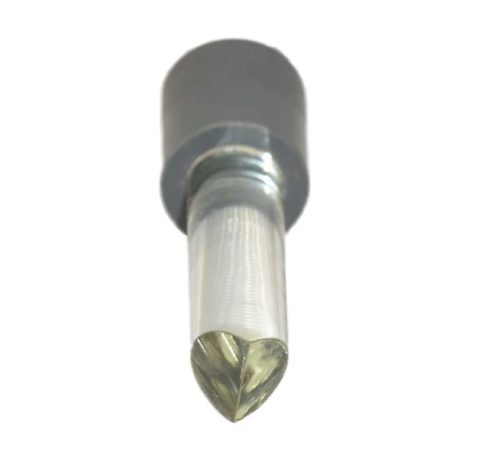 Avoid over filling of your waste bottle. Light sent down into the glass rod is reflected back as long as the liquid surface level is below the glass rod.As soon as the liquid level reaches the glass rod the light is scattered away from the glass rod and the sensor detects this and gives an output. The level sensor is normally mounted on a bottle cap or similar. It consists of a ground glass rod, and electronics for detecting fluid on the rod end. The level sensor is powered by 5VDC and the output is a TTL. When the liquid level is below the glass rod the output is high (+5 VDC), and when the liquid reaches the glass rod the output is low (0 VDC). A visual and acoustic alarm is built-in to the level sensor which signals light and sound through a LED and a buzzer when the liquid reaches the glass rod. This is an OEM product that we can customize for your need!
 -
 The SmartSaver™ solvent recycler from Biotech Fluidics saves up to 90% of mobile phase by redirection of the pure solvent to the solvent reservoir during the isocratic HPLC. Can be used with almost all manufacturers equipment and detectors as UV, fluorescens etc. SmartSaver™ brings quite new approach to solvent recycler design. Very compact instrument is powered directly from chromatography data system PC, no power adapter is required. User friendly software is provided to configure the parameters, and to perform on-line monitoring/audit trail. Analog input allows unipolar or bipolar operation within range of ± 1V. TTL/contact closure can be configured as start, auto-zero or valve position control input. This model has a PEEK solvent flow path, but the SmartSaver™ is also available with wetted material in PTFE.
 -
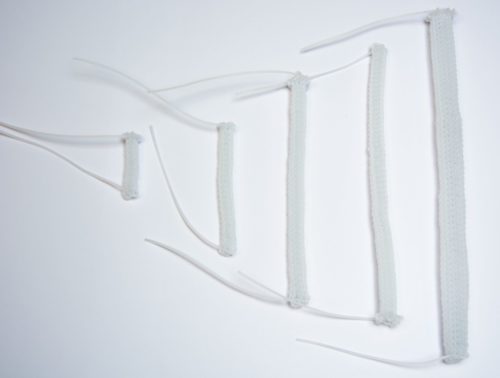 The Reaction Delay Coils from Biotech Fluidics are reactors made from PTFE tubing knitted into a tortuous path to force the fast-moving centre of the liquid stream to mix radially with the slower moving boundary liquid layer. This technique minimizes the axial dispersion while accelerating the radial mixing. The shape of a chromatographic peak entering the reactor is in this way preserved very efficiently. The Reaction Delay Coil is the most optimal delay element for use in any plug flow systems. It is typically inserted in the flow path to create a delay so that a reaction that requires a certain time can take place. Different reaction times are accomplished by changing the inner diameter and length of the Reaction Delay Coil. To ensure a stable radial mixing a linear flow rate of 10 cm/s or more is recommended. The Reaction Delay Coils are available with inner diameter (ID) of 0.25, 0.50, and 0.75 mm, in lengths of 1, 2, 4, 5, and 10 m. Example of applications include efficient mixing of two fluidic streams, delay coil in a fluidic system, in-line derivatization of a sample with UV light, etc. Reaction Delay Coils are also known as Knitted Open Tubular Reactors, or KOT reactors for short.
 -
The Biotech knitted open tubular (KOT) reactors are made from tubing which has been knitted into a tortuous path to force the fast moving centre of the liquid stream to mix radially with the slower moving boundary liquid layer, thereby minimizing the axial dispersion. The shape of a chromatographic peak entering the reactor is thus preserved very efficiently. To ensure a stable radial mixing within the KOT, a linear flow rate of 10 cm/s or more is recommended. The KOT reactor is usually the most optimal delay element for use in analytical flow systems, and is typically inserted in the flow path to create a delay line, so that a reaction or other event that requires a certain time can take place. Example of applications: effecient mixing of two fluidic streams, delay coil in a fluidic system, on-line derivatization of a sample with UV light etc.
-
The Reaction Delay Coils from Biotech Fluidics are reactors made from PTFE tubing knitted into a tortuous path to force the fast-moving centre of the liquid stream to mix radially with the slower moving boundary liquid layer. This technique minimizes the axial dispersion while accelerating the radial mixing. The shape of a chromatographic peak entering the reactor is in this way preserved very efficiently. The Reaction Delay Coil is the most optimal delay element for use in any plug flow systems. It is typically inserted in the flow path to create a delay so that a reaction that requires a certain time can take place. Different reaction times are accomplished by changing the inner diameter and length of the Reaction Delay Coil. To ensure a stable radial mixing a linear flow rate of 10 cm/s or more is recommended. The Reaction Delay Coils are available with inner diameter (ID) of 0.25, 0.50, and 0.75 mm, in lengths of 1, 2, 4, 5, and 10 m. Example of applications include efficient mixing of two fluidic streams, delay coil in a fluidic system, in-line derivatization of a sample with UV light, etc. Reaction Delay Coils are also known as Knitted Open Tubular Reactors, or KOT reactors for short.
-
The Reaction Delay Coils from Biotech Fluidics are reactors made from PTFE tubing knitted into a tortuous path to force the fast-moving centre of the liquid stream to mix radially with the slower moving boundary liquid layer. This technique minimizes the axial dispersion while accelerating the radial mixing. The shape of a chromatographic peak entering the reactor is in this way preserved very efficiently. The Reaction Delay Coil is the most optimal delay element for use in any plug flow systems. It is typically inserted in the flow path to create a delay so that a reaction that requires a certain time can take place. Different reaction times are accomplished by changing the inner diameter and length of the Reaction Delay Coil. To ensure a stable radial mixing a linear flow rate of 10 cm/s or more is recommended. The Reaction Delay Coils are available with inner diameter (ID) of 0.25, 0.50, and 0.75 mm, in lengths of 1, 2, 4, 5, and 10 m. Example of applications include efficient mixing of two fluidic streams, delay coil in a fluidic system, in-line derivatization of a sample with UV light, etc. Reaction Delay Coils are also known as Knitted Open Tubular Reactors, or KOT reactors for short.
-
The Reaction Delay Coils from Biotech Fluidics are reactors made from PTFE tubing knitted into a tortuous path to force the fast-moving centre of the liquid stream to mix radially with the slower moving boundary liquid layer. This technique minimizes the axial dispersion while accelerating the radial mixing. The shape of a chromatographic peak entering the reactor is in this way preserved very efficiently. The Reaction Delay Coil is the most optimal delay element for use in any plug flow systems. It is typically inserted in the flow path to create a delay so that a reaction that requires a certain time can take place. Different reaction times are accomplished by changing the inner diameter and length of the Reaction Delay Coil. To ensure a stable radial mixing a linear flow rate of 10 cm/s or more is recommended. The Reaction Delay Coils are available with inner diameter (ID) of 0.25, 0.50, and 0.75 mm, in lengths of 1, 2, 4, 5, and 10 m. Example of applications include efficient mixing of two fluidic streams, delay coil in a fluidic system, in-line derivatization of a sample with UV light, etc. Reaction Delay Coils are also known as Knitted Open Tubular Reactors, or KOT reactors for short.
