-
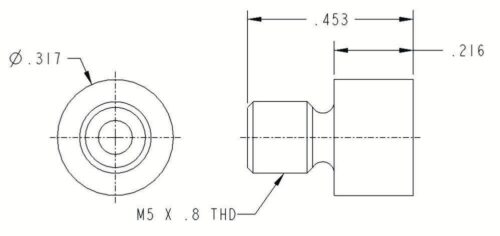
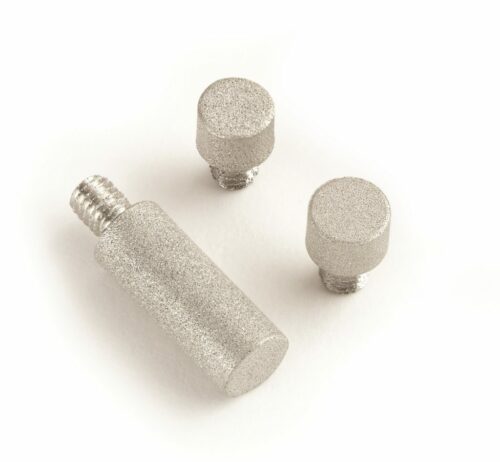 The Mott Micro Gas Spargers are manufactured in durable porous stainless steel. By efficiently creating microbubbles of the gas, these spargers greatly increase contact area of between the liquid and the gas, thereby significantly boosting mass transfer rates and reaction yields or reducing total gas consumption. Available in different lengths, with media porosity grades of 2, 5, 10, or 15 μm, these micro spargers offer the flexibility to generate bubble sizes which are optimal for your specific setup. The sparger tips come with a M5x0.8 thread with O-ring groove, or 10-32 UNF thread as standard.
 -
The Mott Micro Gas Spargers are manufactured in durable porous stainless steel. By efficiently creating microbubbles of the gas, these spargers greatly increase contact area of between the liquid and the gas, thereby significantly boosting mass transfer rates and reaction yields or reducing total gas consumption. Available in different lengths, with media porosity grades of 2, 5, 10, or 15 μm, these micro spargers offer the flexibility to generate bubble sizes which are optimal for your specific setup. The sparger tips come with a M5x0.8 thread with O-ring groove, or 10-32 UNF thread as standard.
-
The Mott Micro Gas Spargers are manufactured in durable porous stainless steel. By efficiently creating microbubbles of the gas, these spargers greatly increase contact area of between the liquid and the gas, thereby significantly boosting mass transfer rates and reaction yields or reducing total gas consumption. Available in different lengths, with media porosity grades of 2, 5, 10, or 15 μm, these micro spargers offer the flexibility to generate bubble sizes which are optimal for your specific setup. The sparger tips come with a M5x0.8 thread with O-ring groove, or 10-32 UNF thread as standard.
-
The Mott Micro Gas Spargers are manufactured in durable porous stainless steel. By efficiently creating microbubbles of the gas, these spargers greatly increase contact area of between the liquid and the gas, thereby significantly boosting mass transfer rates and reaction yields or reducing total gas consumption. Available in different lengths, with media porosity grades of 2, 5, 10, or 15 μm, these micro spargers offer the flexibility to generate bubble sizes which are optimal for your specific setup. The sparger tips come with a M5x0.8 thread with O-ring groove, or 10-32 UNF thread as standard.
-
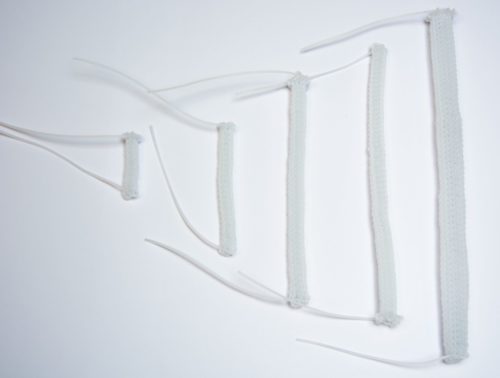 The Biotech knitted open tubular (KOT) reactors are made from tubing which has been knitted into a tortuous path to force the fast moving centre of the liquid stream to mix radially with the slower moving boundary liquid layer, thereby minimizing the axial dispersion. The shape of a chromatographic peak entering the reactor is thus preserved very efficiently. To ensure a stable radial mixing within the KOT, a linear flow rate of 10 cm/s or more is recommended. The KOT reactor is usually the most optimal delay element for use in analytical flow systems, and is typically inserted in the flow path to create a delay line, so that a reaction or other event that requires a certain time can take place. Example of applications: effecient mixing of two fluidic streams, delay coil in a fluidic system, on-line derivatization of a sample with UV light etc.
 -
The Reaction Delay Coils from Biotech Fluidics are reactors made from PTFE tubing knitted into a tortuous path to force the fast-moving centre of the liquid stream to mix radially with the slower moving boundary liquid layer. This technique minimizes the axial dispersion while accelerating the radial mixing. The shape of a chromatographic peak entering the reactor is in this way preserved very efficiently. The Reaction Delay Coil is the most optimal delay element for use in any plug flow systems. It is typically inserted in the flow path to create a delay so that a reaction that requires a certain time can take place. Different reaction times are accomplished by changing the inner diameter and length of the Reaction Delay Coil. To ensure a stable radial mixing a linear flow rate of 10 cm/s or more is recommended. The Reaction Delay Coils are available with inner diameter (ID) of 0.25, 0.50, and 0.75 mm, in lengths of 1, 2, 4, 5, and 10 m. Example of applications include efficient mixing of two fluidic streams, delay coil in a fluidic system, in-line derivatization of a sample with UV light, etc. Reaction Delay Coils are also known as Knitted Open Tubular Reactors, or KOT reactors for short.
-
The Reaction Delay Coils from Biotech Fluidics are reactors made from PTFE tubing knitted into a tortuous path to force the fast-moving centre of the liquid stream to mix radially with the slower moving boundary liquid layer. This technique minimizes the axial dispersion while accelerating the radial mixing. The shape of a chromatographic peak entering the reactor is in this way preserved very efficiently. The Reaction Delay Coil is the most optimal delay element for use in any plug flow systems. It is typically inserted in the flow path to create a delay so that a reaction that requires a certain time can take place. Different reaction times are accomplished by changing the inner diameter and length of the Reaction Delay Coil. To ensure a stable radial mixing a linear flow rate of 10 cm/s or more is recommended. The Reaction Delay Coils are available with inner diameter (ID) of 0.25, 0.50, and 0.75 mm, in lengths of 1, 2, 4, 5, and 10 m. Example of applications include efficient mixing of two fluidic streams, delay coil in a fluidic system, in-line derivatization of a sample with UV light, etc. Reaction Delay Coils are also known as Knitted Open Tubular Reactors, or KOT reactors for short.
-
The Reaction Delay Coils from Biotech Fluidics are reactors made from PTFE tubing knitted into a tortuous path to force the fast-moving centre of the liquid stream to mix radially with the slower moving boundary liquid layer. This technique minimizes the axial dispersion while accelerating the radial mixing. The shape of a chromatographic peak entering the reactor is in this way preserved very efficiently. The Reaction Delay Coil is the most optimal delay element for use in any plug flow systems. It is typically inserted in the flow path to create a delay so that a reaction that requires a certain time can take place. Different reaction times are accomplished by changing the inner diameter and length of the Reaction Delay Coil. To ensure a stable radial mixing a linear flow rate of 10 cm/s or more is recommended. The Reaction Delay Coils are available with inner diameter (ID) of 0.25, 0.50, and 0.75 mm, in lengths of 1, 2, 4, 5, and 10 m. Example of applications include efficient mixing of two fluidic streams, delay coil in a fluidic system, in-line derivatization of a sample with UV light, etc. Reaction Delay Coils are also known as Knitted Open Tubular Reactors, or KOT reactors for short.
-
The Reaction Delay Coils from Biotech Fluidics are reactors made from PTFE tubing knitted into a tortuous path to force the fast-moving centre of the liquid stream to mix radially with the slower moving boundary liquid layer. This technique minimizes the axial dispersion while accelerating the radial mixing. The shape of a chromatographic peak entering the reactor is in this way preserved very efficiently. The Reaction Delay Coil is the most optimal delay element for use in any plug flow systems. It is typically inserted in the flow path to create a delay so that a reaction that requires a certain time can take place. Different reaction times are accomplished by changing the inner diameter and length of the Reaction Delay Coil. To ensure a stable radial mixing a linear flow rate of 10 cm/s or more is recommended. The Reaction Delay Coils are available with inner diameter (ID) of 0.25, 0.50, and 0.75 mm, in lengths of 1, 2, 4, 5, and 10 m. Example of applications include efficient mixing of two fluidic streams, delay coil in a fluidic system, in-line derivatization of a sample with UV light, etc. Reaction Delay Coils are also known as Knitted Open Tubular Reactors, or KOT reactors for short.
-
The Reaction Delay Coils from Biotech Fluidics are reactors made from PTFE tubing knitted into a tortuous path to force the fast-moving centre of the liquid stream to mix radially with the slower moving boundary liquid layer. This technique minimizes the axial dispersion while accelerating the radial mixing. The shape of a chromatographic peak entering the reactor is in this way preserved very efficiently. The Reaction Delay Coil is the most optimal delay element for use in any plug flow systems. It is typically inserted in the flow path to create a delay so that a reaction that requires a certain time can take place. Different reaction times are accomplished by changing the inner diameter and length of the Reaction Delay Coil. To ensure a stable radial mixing a linear flow rate of 10 cm/s or more is recommended. The Reaction Delay Coils are available with inner diameter (ID) of 0.25, 0.50, and 0.75 mm, in lengths of 1, 2, 4, 5, and 10 m. Example of applications include efficient mixing of two fluidic streams, delay coil in a fluidic system, in-line derivatization of a sample with UV light, etc. Reaction Delay Coils are also known as Knitted Open Tubular Reactors, or KOT reactors for short.
-
The Reaction Delay Coils from Biotech Fluidics are reactors made from PTFE tubing knitted into a tortuous path to force the fast-moving centre of the liquid stream to mix radially with the slower moving boundary liquid layer. This technique minimizes the axial dispersion while accelerating the radial mixing. The shape of a chromatographic peak entering the reactor is in this way preserved very efficiently. The Reaction Delay Coil is the most optimal delay element for use in any plug flow systems. It is typically inserted in the flow path to create a delay so that a reaction that requires a certain time can take place. Different reaction times are accomplished by changing the inner diameter and length of the Reaction Delay Coil. To ensure a stable radial mixing a linear flow rate of 10 cm/s or more is recommended. The Reaction Delay Coils are available with inner diameter (ID) of 0.25, 0.50, and 0.75 mm, in lengths of 1, 2, 4, 5, and 10 m. Example of applications include efficient mixing of two fluidic streams, delay coil in a fluidic system, in-line derivatization of a sample with UV light, etc. Reaction Delay Coils are also known as Knitted Open Tubular Reactors, or KOT reactors for short.
-
The Reaction Delay Coils from Biotech Fluidics are reactors made from PTFE tubing knitted into a tortuous path to force the fast-moving centre of the liquid stream to mix radially with the slower moving boundary liquid layer. This technique minimizes the axial dispersion while accelerating the radial mixing. The shape of a chromatographic peak entering the reactor is in this way preserved very efficiently. The Reaction Delay Coil is the most optimal delay element for use in any plug flow systems. It is typically inserted in the flow path to create a delay so that a reaction that requires a certain time can take place. Different reaction times are accomplished by changing the inner diameter and length of the Reaction Delay Coil. To ensure a stable radial mixing a linear flow rate of 10 cm/s or more is recommended. The Reaction Delay Coils are available with inner diameter (ID) of 0.25, 0.50, and 0.75 mm, in lengths of 1, 2, 4, 5, and 10 m. Example of applications include efficient mixing of two fluidic streams, delay coil in a fluidic system, in-line derivatization of a sample with UV light, etc. Reaction Delay Coils are also known as Knitted Open Tubular Reactors, or KOT reactors for short.
